
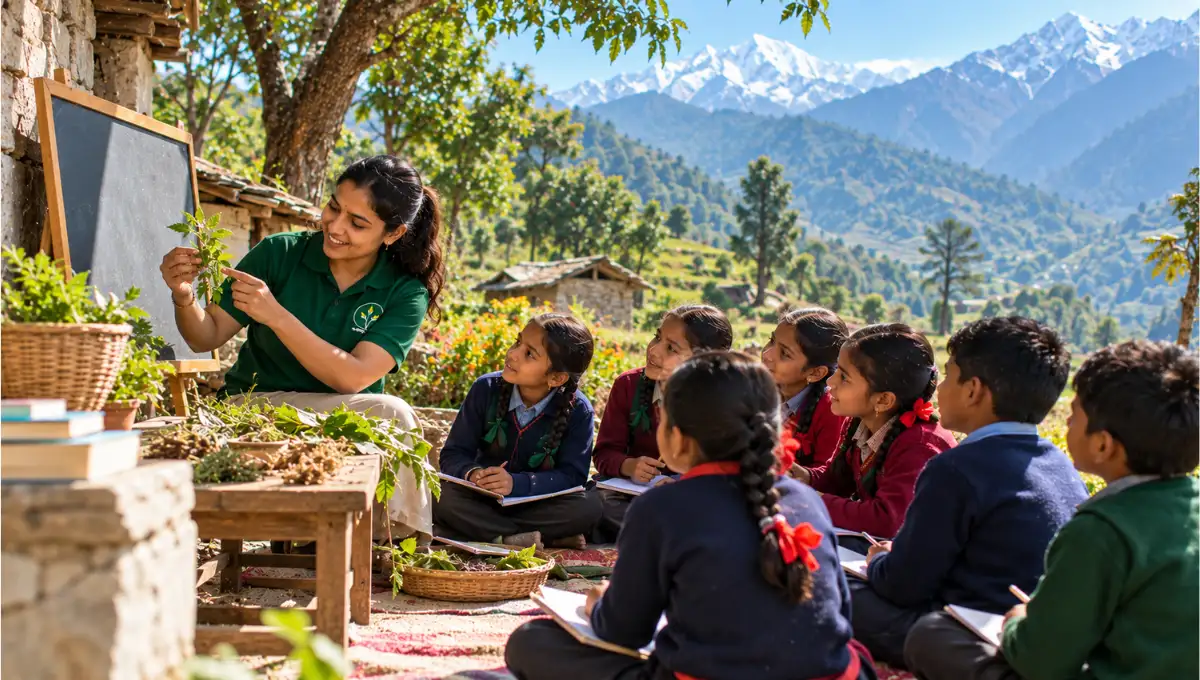
How ACTIZEET® Cares Is Bringing Classrooms to Hillsides
In India's hill villages, the road to school can mean a steep climb, a stream to cross and a long walk back before dark. Snow, landslides and monsoon rains close paths for days at a time. ACTIZEET® Cares believes a child's chance to learn should not depend on the slope of the land they live on. This is how the idea of bringing the classroom closer to hillside homes works in practice.
Ask a child in a mountain village what school is like, and you may hear about the walk before you hear about the lessons. For many families in Uttarakhand, Himachal Pradesh, Jammu and Kashmir, Sikkim and the hill districts of the Northeast, getting to class is a daily test of stamina and weather. Schools are often small, teachers are stretched thin, and books, lights and internet access can be hard to find.
This article explains how ACTIZEET® Cares approaches education in hill villages. It covers the real barriers mountain children face, the model of support built around them, what changes when learning comes closer to home, and what other CSR teams and community groups can take from this work.
The Challenge of Learning in the Hills
India has made big gains in school enrolment over the last two decades. Most villages now have a primary school within reach, and schemes such as Samagra Shiksha and the Mid-Day Meal program (now PM POSHAN) have brought more children through the school gate. Enrolment, however, is only the first step. In hill regions, keeping children in class and making sure they actually learn is a much harder task.
Distance and Difficult Terrain
A school two kilometres away on a map can be an hour's climb on foot. Younger children tire quickly, and parents worry about slippery paths, wild animals and swollen streams. During heavy monsoon or winter snow, attendance can drop sharply for weeks. Every missed week makes it harder for a child to catch up.
Small Schools, Few Teachers
Many hill schools have very few students spread across several grades. Government data from UDISE+ shows that India still has more than a lakh single-teacher schools, and a good share of them are in remote or hilly districts. One teacher handling five classes at once cannot give every child the attention they need, especially children who are just learning to read.
Limited Resources at Home
Once children get home, the learning often stops. There may be no quiet place to study, few storybooks, and no steady electricity after sunset. Parents who work long hours in fields, orchards or tourism jobs may not have had much schooling themselves, so helping with homework is hard. Mobile networks are patchy, which rules out much of the online learning that city children take for granted.
Migration and Seasonal Work
In many hill districts, young people leave for jobs in the plains. Older children, especially girls, may be kept home to help with younger siblings, cattle or household work. When school feels far away and hard to reach, dropping out can seem like the easy choice.
The ACTIZEET® Cares Approach
The thinking behind this work is straightforward. If children cannot easily reach the classroom, part of the classroom should come to them. That does not mean replacing government schools. It means filling the gaps around them: the evening hours, the snowed-in weeks, the missing books and the teacher who needs support.
The model rests on seven connected pieces. Each one is simple on its own, but together they create a learning network that fits hill life rather than fighting against it.
A community learning centre can be a spare room in a panchayat building, a corner of a temple courtyard or a space offered by a village family. What matters is that it sits close to where children live. Centres open after school hours and on holidays, giving children a warm, lit place to read, do homework and ask questions. During weather closures, they keep learning going when the main school is out of reach.
Each centre is run by a local facilitator, often a young person from the village who has finished school or college. Hiring locally means the facilitator speaks the children's language, knows their families and is not going to leave after a hard winter. Facilitators receive training in activity-based teaching, handling mixed-age groups and tracking each child's progress. Where possible, they work alongside government school teachers so both are pulling in the same direction.
A child who cannot read fluently by Grade 3 struggles with every subject after that. Following the direction of NEP 2020 and the NIPUN Bharat mission, the centres put foundational literacy and numeracy first. Children are grouped by learning level, not age, so a ten-year-old who is still learning letters gets the right help without feeling left behind. Games, local stories, counting with pebbles and pine cones, and songs in the mother tongue keep sessions lively.
Simple tools make a surprising difference. Children receive study kits with notebooks, pencils, geometry sets and warm bags that keep books dry in the rain. Each centre builds a small library of picture books and graded readers that children can borrow. Solar study lamps let children read after dark in homes where power cuts are common, turning evening hours into study time.
Online classes are not realistic where the signal drops every few minutes. Instead, centres use tablets or laptops loaded with offline lessons, videos and practice activities, charged by solar power where needed. Content from government platforms such as DIKSHA can be downloaded in advance. Children get exposure to technology and interactive lessons without needing a constant internet connection.
Girls in hill regions often carry heavy household duties, and the long walk to school raises safety worries for parents. Nearby centres, female facilitators where possible, and group walking arrangements help ease these concerns. Awareness sessions with families highlight the value of girls finishing school, and older girls are encouraged to become reading buddies for younger children, which builds their confidence and leadership.
Education lasts longer when the whole village owns it. Regular parent meetings share how children are doing in simple terms, such as "she can now read a short story." Mothers' groups and village elders help choose centre timings and locations, and some families donate space, firewood for winter or a few hours of volunteer time. This shared ownership keeps centres running through tough seasons.
Every ACTIZEET® choice helps support the communities ACTIZEET® Cares works with.
Explore ACTIZEET®Before and After at a Glance
The table below shows the kind of shift this model aims for when learning support comes closer to hillside homes.
| Area | Common Situation Before | With Hillside Learning Support |
|---|---|---|
| Access | Long, risky walks; learning stops in bad weather | A lit, safe learning space within walking distance |
| Teaching | One teacher managing several grades | Extra help from trained local facilitators |
| Reading and maths | Many children behind grade level | Level-based groups focused on basics |
| Study at home | No books, no light after dark | Study kits, library books and solar lamps |
| Technology | Little or no digital exposure | Offline digital lessons on shared devices |
| Community role | Parents unsure how to help | Parents informed and involved in decisions |
A Day at a Hillside Learning Centre
To picture how this works, imagine an afternoon at a small centre in a hill village. School ends around two, and by three the first children arrive, some still in uniform, cheeks red from the climb. The facilitator greets them by name and starts with a short song to settle the group.
The younger children sit in a circle with picture cards, matching letters to sounds. In another corner, a group of older children works on fractions using folded paper and a story about sharing apples from the orchard. Two girls from Class 7 help the little ones sound out words, proud to be trusted as helpers.
Around four, the tablet comes out. Children take turns watching a short science video on water and weather, then talk about why their stream runs faster after rain. Before the light fades, everyone picks a library book to take home, and the facilitator notes in a simple register who has improved and who needs more help tomorrow.
It is not a grand building or a high-tech lab. It is something quieter and, for many families, more valuable: a steady, welcoming place where learning continues every day.
What Changes When the Classroom Comes Closer
Stronger Learning Foundations
When children get daily practice in reading and basic maths, the gains build up. Children who were silent in class begin reading aloud. Those who counted on their fingers start solving word problems. Teachers in the main school often notice that centre children follow lessons more easily and ask more questions.
Better Attendance and Fewer Dropouts
Children who feel confident in class are far less likely to drop out. The centres also give families a reason to keep children connected to learning during bad-weather weeks, so fewer children fall so far behind that they give up.
Confidence and Wider Dreams
Exposure to books, videos and new ideas widens what children imagine for themselves. A child who has only seen farming and tourism jobs starts talking about becoming a nurse, an engineer or a forest officer. For girls especially, seeing a young woman from their own village running the centre sends a powerful message.
Local Jobs and Leadership
Facilitator roles create respected local work for educated young people who might otherwise migrate. Many find they enjoy teaching and go on to further training, which strengthens the education pool in the region over time.
Challenges Along the Way
Honest outreach means naming the hard parts too. Harsh winters make it difficult to heat centres and keep attendance steady. Recruiting and keeping trained facilitators in very remote hamlets takes patience. Devices need care in cold and damp conditions, and books wear out quickly with heavy use. Each of these is managed step by step, through winter timetables, refresher training, protective storage and regular restocking, with the community's help at every stage.
Working With the Seasons, Not Against Them
Hill life follows the calendar of weather and harvest, so the centres do too. In peak winter, sessions move to the warmest hours of the day and may shift into a family home with a stove. During apple, potato or tea picking seasons, timings move earlier or later so children can help their families and still attend. Before long closures, children take home extra reading books and simple worksheets, and facilitators visit hamlets on foot when paths allow. This flexibility is what keeps learning steady through the year, instead of stopping every time the weather turns.
Lessons for Educational Outreach in Remote Regions
For NGOs, CSR teams and community leaders who want to support rural education in India, especially in the hills, these principles tend to hold true.
- Support government schools rather than compete with them; fill the gaps around the school day.
- Hire and train local facilitators who understand the language, culture and seasons.
- Teach at the child's level, with foundational reading and maths as the first priority.
- Plan for weather, with winter and monsoon schedules built in from the start.
- Choose offline and solar-powered tools that work without steady power or internet.
- Make girls' safety and participation a clear, stated goal.
- Involve parents and panchayats so the community owns the effort.
- Track simple, clear progress so families and partners can see change.
ACTIZEET® Cares believes every child deserves a fair chance to learn, whether they live beside a highway or at the top of a mountain path. Bringing classrooms closer to hillside homes is one way of making that belief real.
Learn More About ACTIZEET® Cares →Frequently Asked Questions
Learning That Climbs the Hill
Bringing classrooms to hillsides is not about big buildings or quick fixes. It is about a lit room within walking distance, a trained facilitator who knows every child's name, a bag of books that stays dry in the rain and a village that believes its children's education matters. Step by step, these small pieces add up to something that changes lives.
ACTIZEET® Cares will keep supporting educational outreach that meets children where they are, because talent is spread evenly across India's valleys and peaks, even when opportunity is not.
Sources referenced: Ministry of Education, Government of India (NEP 2020, NIPUN Bharat, Samagra Shiksha), UDISE+ and DIKSHA.
Latest from Our Blog

How We Are Introducing Ayurveda to Young Minds
See how ACTIZEET® Cares is introducing Ayurveda to young minds...
Learning in the Shade of a Tree: Rural Schooling Models
Explore how rural India is redefining education under trees and...
Digital Literacy in the Last Mile
Discover how digital literacy is transforming remote Himalayan villages—empowering women,...
Teaching the Value of Clean Water and Hygiene
Discover how ACTIZEET’s hygiene education programs are transforming rural communities—empowering...

