Why the Himalayas Are More Than a Landscape
Most people meet the Himalayas through a photograph, a postcard view, a travel reel, snow-capped peaks against a clear sky. It is a stunning image, and not an inaccurate one. But spend real time in these mountains, working alongside the people who actually live there, and the landscape stops being the whole story. This is a reflection on everything that view leaves out.
Over the years, ACTIZEET® Cares has spent time in hill and mountain communities across the Himalayan belt, supporting work on waste management, traditional herbal knowledge and general community engagement. Every visit has chipped away, a little more each time, at the idea that the Himalayas are simply scenery, a beautiful backdrop to be admired, photographed and left behind.
What we have come to understand instead is that the Himalayas function as something closer to a living system, ecological, cultural and spiritual all at once, one that shapes the people within it as much as it is shaped by them. This piece is an attempt to describe that, honestly and without oversimplifying a place far too complex for any single blog post to fully capture.
The Himalayas as an Idea, Not Just a Place
The word Himalaya itself, from Sanskrit, means abode of snow, and that name alone hints at something beyond simple geography. For the communities who live within this range, the mountains are not scenery to be looked at from a distance, they are the setting for daily life, spiritual practice, seasonal survival and inherited identity, all woven together in a way that is difficult to separate into neat categories.
Outsiders, understandably, tend to encounter the Himalayas primarily through its most photogenic qualities, dramatic peaks, clear mountain air, a sense of scale that feels almost otherworldly. None of that is wrong. But it is only the surface of something far deeper.
What the Himalayas Actually Represent
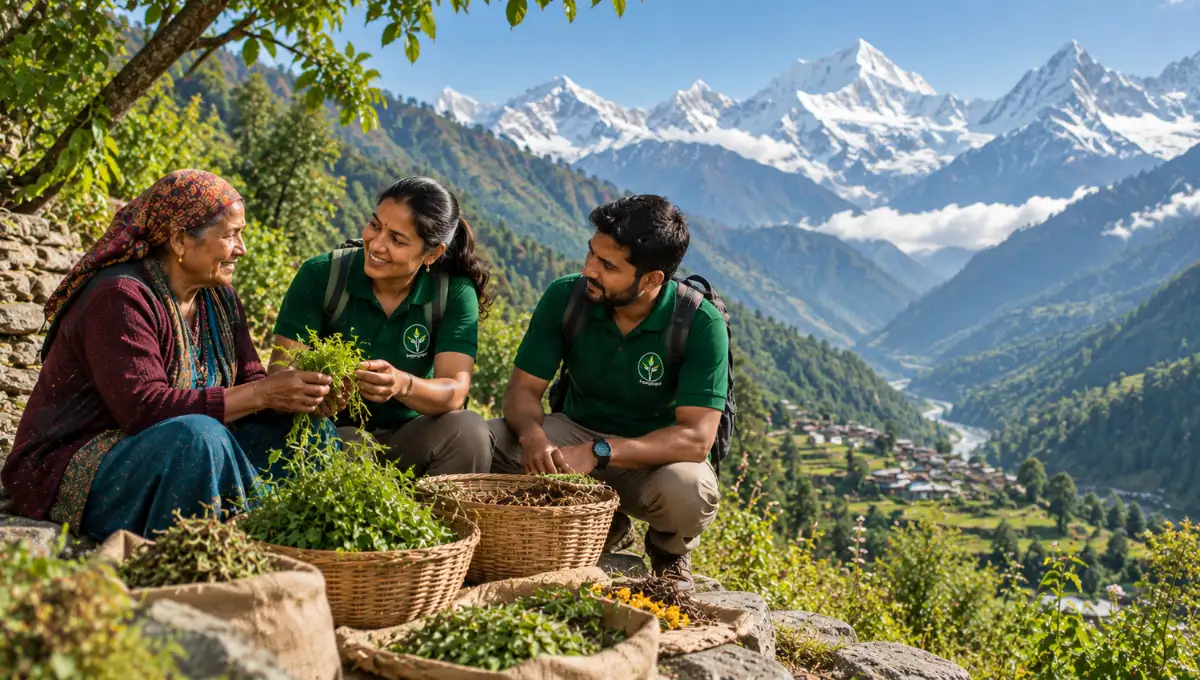
The Himalayas host an extraordinary range of plant and animal life, shifting dramatically across altitude, from dense temperate forests to alpine meadows to cold, arid high-altitude desert. This is not a static backdrop, it is an active, functioning ecosystem, home to countless species and to the traditional knowledge systems, like those held by Himalayan herbalists, built around understanding it closely.
The Himalayan belt is not one culture, it is many. Ladakhi, Lahauli, Sikkimese, Kumaoni and Garhwali communities, among many others, each carry their own languages, customs and ways of relating to the land. Flattening this diversity into a single generic idea of mountain culture erases exactly the richness that makes the region so remarkable in the first place.
For Hindus, several Himalayan peaks and river sources are considered sacred, tied directly to core religious narratives. For Buddhists, particularly across Ladakh, Sikkim and parts of Himachal Pradesh, the mountains hold deep spiritual significance reflected in monasteries, prayer flags and pilgrimage routes woven throughout the landscape. This spiritual weight is inseparable from how many communities experience the mountains daily, not an occasional or ceremonial add-on.
The Himalayas feed some of Asia's major river systems, water that travels far beyond the mountains themselves to support agriculture, drinking water and daily life for enormous populations downstream. What happens ecologically within these mountains, glacial health, forest cover, seasonal weather patterns, has consequences that ripple out to people who may never set foot in the range itself.
Climate change, growing tourism, and shifting patterns of migration are all placing real pressure on Himalayan ecosystems and the communities within them. Glacial retreat, unpredictable weather and waste management challenges, the kind we have written about in our own work on recycling in the hills, are not distant, abstract concerns here, they are immediate, lived realities for the people we work alongside.
Life at high altitude often moves according to seasons and weather in a way that feels almost foreign to those used to urban schedules. Planting, harvesting, herding and even travel are dictated by conditions well beyond human control, fostering a relationship with time that is patient, adaptive and deeply attentive to the immediate environment in a way that is genuinely rare elsewhere.
A visitor passing through for a few days will almost always experience the Himalayas as visual spectacle first. Locals, by contrast, read the same landscape as a working system, which slope holds water longer, which valley floods first, which plant blooms before a weather shift. This gap in perception is not a failure of the visitor, it is simply the natural result of time and relationship, and it is exactly why listening to local voices matters so much in any outside engagement with the region.
Curious about ingredients and traditions rooted in mountain regions like these?
Explore ACTIZEET®What This Means for How We Engage With the Himalayas
Understanding the Himalayas as a living, layered system rather than simple scenery changes how any outside organisation should approach working there, and it has certainly shaped how ACTIZEET® Cares thinks about its own hill-region work. Waste management systems, for instance, cannot simply be copied from urban models, they need to account for terrain, seasonal tourism and fragile local ecosystems, exactly the kind of nuance we explored in our own work on recycling in the hills.
The same principle applies to traditional knowledge. Recognising the depth behind practices like those held by Himalayan herbalists means approaching that knowledge with genuine respect, not extraction, treating it as a complete, living system rather than a collection of isolated facts to be repackaged elsewhere.
How to Engage With the Himalayas Respectfully
Whether you are a visitor, an organisation, or simply someone who cares about the region, a few principles consistently matter for engaging with the Himalayas thoughtfully.
- Recognise that the Himalayas are not one culture, but many distinct communities, languages and traditions.
- Treat local ecological knowledge as valuable expertise, not folklore to be admired from a distance.
- Be mindful of the environmental impact of tourism, waste and resource use in fragile mountain ecosystems.
- Listen to local voices first when supporting any community project or initiative in the region.
- Understand that what happens ecologically in the Himalayas affects millions of people far beyond the mountains themselves.
Frequently Asked Questions
Looking Past the View
The Himalayas will always be breathtaking to look at, and there is nothing wrong with appreciating that. But the mountains are also home, livelihood, spiritual anchor and ecological lifeline for millions of people, a living system far richer and more fragile than any single photograph can capture.
ACTIZEET® Cares continues to learn from the communities we work alongside in this region, carrying that understanding into every project we take on there, because the Himalayas deserve to be seen for everything they actually are, not just how they look from a distance.
Latest from Our Blog
Voices of Change: Youth in the Himalayas
Meet the inspiring youth of the Himalayas who are driving...
Traditional Farming Techniques That Still Work
Discover timeless traditional farming techniques in India that still thrive...