
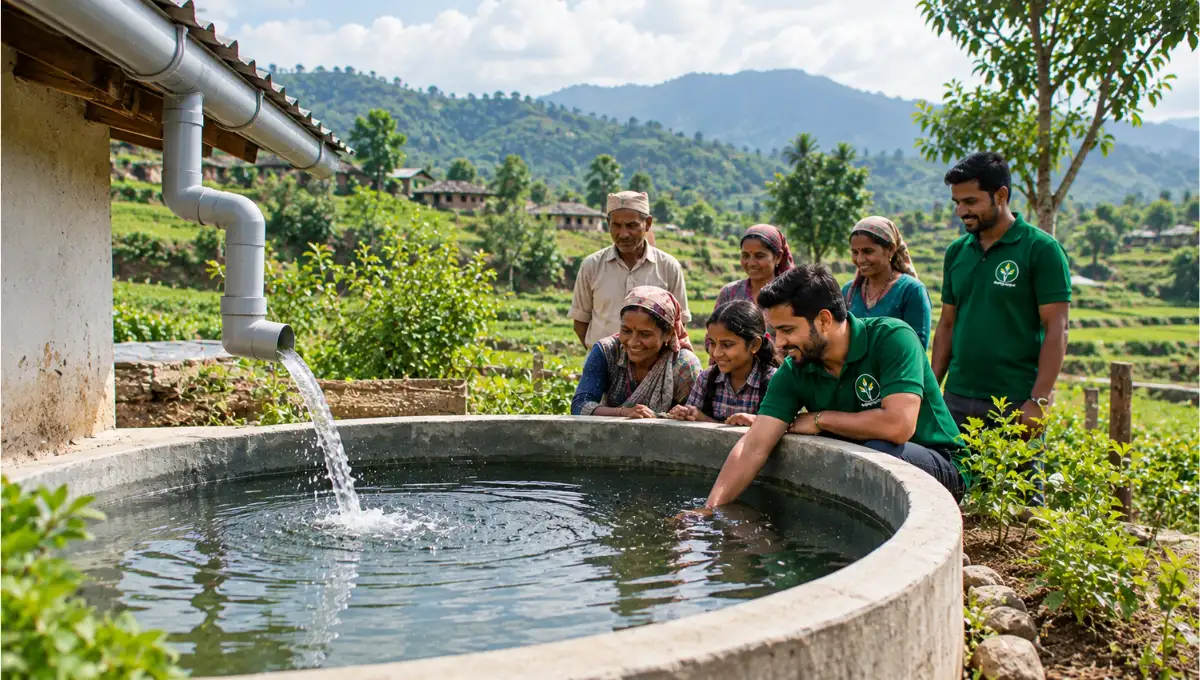
Why Rainwater Harvesting Is Reshaping Rural India
For generations, villages across India built their own ways of catching and storing the monsoon, stepwells, ponds, small check dams, systems shaped by local terrain and passed down through practice rather than manuals. Many of these structures fell into disrepair over the decades. Now, through a mix of revived tradition and coordinated national effort, rainwater harvesting is quietly reshaping how rural India relates to water.
Water scarcity is not a distant or abstract issue for most of rural India, it shapes daily routines, farming decisions and, in many regions, how far someone has to walk just to fetch a bucket of water. Over the past several years, a renewed focus on rainwater harvesting, combining old wisdom with new coordination, has begun to genuinely shift this picture in communities across the country.
This post looks at why rainwater harvesting has become such a significant force in rural community development, the traditional and modern approaches driving this change, and what it means for the future of water security in Indian villages.
Why Rural India Needs Rainwater Harvesting Now
India receives the vast majority of its annual rainfall within just a few concentrated monsoon months, and much of that water historically ran off unused rather than being captured and stored. Groundwater levels across large parts of the country have been declining for years, driven by rising extraction for agriculture, drinking water and changing land use patterns, leaving many villages increasingly vulnerable to seasonal water stress.
Rainwater harvesting addresses this gap directly by capturing water during the monsoon and storing or recharging it for use during drier months, reducing dependence on rapidly depleting groundwater and giving communities a more resilient, locally controlled water supply.
From Ancient Wisdom to Modern Necessity
Long before any national campaign existed, Indian communities had already developed sophisticated, regionally specific rainwater harvesting systems, stepwells known as baolis, small earthen check dams called johads in Rajasthan, and ahars used across parts of Bihar, each shaped by local terrain, rainfall patterns and generations of accumulated knowledge.
According to the Press Information Bureau, Government of India, the Ministry of Jal Shakti's "Jal Shakti Abhiyan - Catch the Rain" campaign, launched on World Water Day in March 2021, explicitly includes the revival of traditional rainwater harvesting structures like stepwells alongside newer construction, treating inherited local knowledge as a genuine asset rather than something to be replaced entirely by modern engineering.
How Rainwater Harvesting Is Reshaping Rural Communities
Rather than treating traditional systems as outdated, current rainwater harvesting efforts across India frequently focus on renovating and reactivating them, desilting old tanks, repairing stepwells and clearing encroachments from ponds and lakes that had gradually fallen out of use. This revival approach respects the local knowledge embedded in these older systems while extending their usefulness for a new generation.
By capturing and storing monsoon rainfall rather than letting it run off, villages gain a supplementary water source that reduces pressure on already stressed groundwater aquifers. This shift matters enormously in regions where borewells have had to be dug deeper and deeper each year just to reach a reliable water table.
A defining feature of recent rainwater harvesting momentum is its emphasis on community participation rather than top-down construction alone. Government-backed programs increasingly rely on a "Jan Bhagidari," or people's participation, model, where local residents help plan, build and maintain recharge structures rather than simply receiving finished infrastructure from outside.
For farming households, a more reliable local water supply can mean the difference between a stable growing season and a failed one. Recharged groundwater and stored rainwater support irrigation during dry spells, helping reduce the year-to-year unpredictability that has historically made small-scale farming so financially precarious in water-stressed regions.
Groundwater recharge does not just refill wells and borewells, it can also restore natural springs that communities had relied on for generations before they dried up. Documented community efforts have reported springs returning to flow in remote tribal hamlets after sustained, locally led water conservation work, a tangible sign of ecological as well as practical recovery.
Water collection has traditionally fallen disproportionately on women and girls in rural India, often consuming significant daily time and effort. Recent water conservation initiatives have deliberately built in structured roles for women in local planning and decision-making, recognising both their direct stake in water access and their practical knowledge of household water needs.
As rainfall patterns grow less predictable due to climate change, the ability to capture and store water during heavy rain events becomes increasingly important for long-term resilience. Rainwater harvesting infrastructure built today is, in many ways, preparation for a future where water availability may fluctuate even more than it already does.
Interested in the communities and initiatives ACTIZEET® Cares supports?
Explore ACTIZEET®Rainwater Harvesting Methods at a Glance
| Method | How It Works | Common Setting |
|---|---|---|
| Rooftop harvesting | Collects rainwater from roofs into storage tanks or recharge pits | Homes, schools, public buildings |
| Check dams | Small barriers slow water flow, allowing it to seep into the ground | Seasonal streams and rural watersheds |
| Percolation ponds | Shallow ponds allow collected water to gradually recharge groundwater | Agricultural and semi-arid regions |
| Revived stepwells | Traditional stepped structures store and provide access to water | Western and northern India, particularly Rajasthan and Gujarat |
| Farm ponds | On-farm water storage for irrigation during dry periods | Rural agricultural land |
What This Means for Community Development Going Forward
ACTIZEET® Cares believes sustainable community development means supporting solutions that communities can own and maintain long after outside attention moves elsewhere. Rainwater harvesting, especially when it revives and respects traditional local knowledge, reflects exactly this kind of durable, community-led approach.
Learn More About ACTIZEET® Cares →The shift toward rainwater harvesting represents something broader than infrastructure alone, it reflects a growing recognition that rural water security depends on local ownership, traditional knowledge and consistent maintenance, not just one-time construction. Villages that maintain and expand these systems over multiple seasons tend to see the most durable improvements in water availability.
How Communities Can Get Involved
Communities looking to build or strengthen their own rainwater harvesting efforts can draw on a few consistent, practical principles.
- Assess and repair existing traditional water structures before building new ones from scratch.
- Involve local residents, including women, directly in planning and decision-making from the start.
- Match harvesting methods to local terrain and rainfall patterns rather than applying a generic template.
- Build in a clear maintenance plan, since structures left unmaintained quickly lose effectiveness.
- Connect with existing government schemes and local water conservation programs where available.
Frequently Asked Questions
Water Security Built From the Ground Up
Rainwater harvesting is reshaping rural India not through any single dramatic intervention, but through the steady accumulation of revived stepwells, recharged borewells, community-led recharge structures and a renewed respect for knowledge that rural communities had already developed generations ago. The results, rising groundwater tables, returning springs and more resilient farming seasons, speak for themselves.
ACTIZEET® Cares continues to support community development approaches that put local knowledge and ownership first, because lasting change in rural India tends to grow from the ground up, not the other way around.
Sources referenced: Press Information Bureau, Government of India and the Ministry of Jal Shakti's Jal Sanchay Jan Bhagidari feature.
Latest from Our Blog
Village by Village: Our Blueprint for Upliftment
Discover how ACTIZEET is uplifting Himalayan communities—village by village—through herbal...
Reviving Village Markets Through Herbal Collectives
Discover how herbal collectives are reviving rural markets in the...
Creating Community Health Committees: A Success Story
Discover how ACTIZEET is transforming rural healthcare through Community Health...

ACTIZEET® Cares Rural Internship Program: What We Learned
Discover key lessons from the ACTIZEET® Cares Rural Internship Program,...

