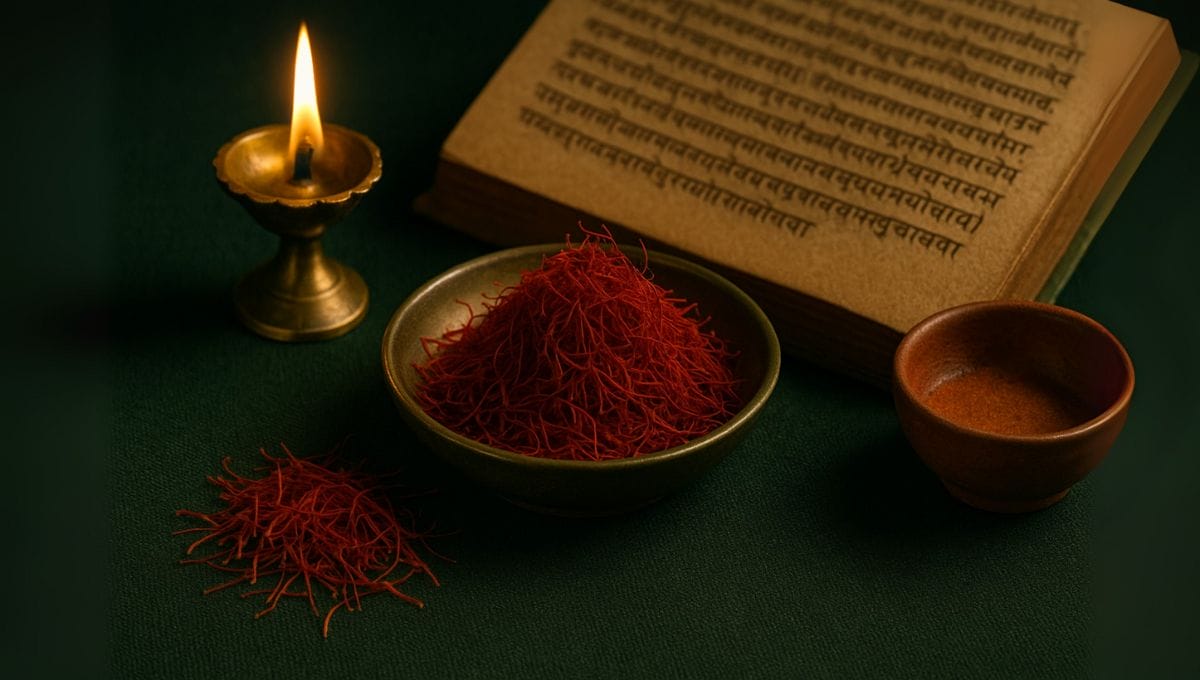
A Golden Thread Through Time
Close your eyes and imagine the first rays of the sun touching the Himalayan slopes. Among the wildflowers grows a delicate purple blossom holding within it the world’s most precious golden strands – saffron. For thousands of years, this golden spice has travelled from mountains to temples, scriptures to homes, weaving itself deeply into India’s spiritual heritage.
Today, let us journey together to explore how saffron’s spiritual significance began in ancient Indian texts like the Vedas and Upanishads, and how it continues to bless your pooja thali and prayers even today.
Saffron in Ancient Scriptures – The Vedic Age
Saffron in the Vedas
The earliest mentions of saffron (kesar) appear in the Rig Veda and Atharva Veda, where it is praised for:
- Its satvik (pure) energy.
- Its ability to purify spaces and minds.
- Its use as an offering to gods during yajnas (fire rituals).
Imagine Vedic rishis chanting mantras at dawn, pouring ghee, grains, and saffron into the sacred fire. Its golden hue symbolised Agni (fire god) and Surya (sun god), connecting humans to divine light.
Saffron in the Upanishads
The Upanishads, known for their deep spiritual philosophies, refer to saffron as a symbol of:
- Sacrifice and renunciation, aligning with the orange robes worn by monks and sages.
- Inner illumination, as saffron’s colour represents the flame of knowledge burning away ignorance.
For example, in the Chandogya Upanishad, saffron is described as an essence of earth, representing purity and spiritual wealth.
Saffron in Ancient Ritual Practices
Creating Saffron Tilak
Since Vedic times, saffron was mixed with water or milk to create tilak, applied on:
- Deities’ idols, symbolising devotion and purity.
- Foreheads of devotees, activating the Ajna chakra (third eye) for intuition and focus.
When you place saffron tilak on your forehead today, you continue this unbroken tradition that began thousands of years ago.
Saffron in Ayurvedic Texts
Ancient Ayurvedic texts like Charaka Samhita describe saffron as:
- A rasayana (rejuvenator) that heals body, mind, and spirit.
- A herb that balances doshas, calms the nervous system, and enhances spiritual practices.
Ayurveda recommended saffron-infused milk before meditation to clear the mind and awaken inner light – a practice still followed by spiritual seekers across India.
Saffron in Medieval Spiritual Traditions
Bhakti Movement and Saffron
During the medieval Bhakti movement:
- Saints like Kabir and Mirabai mentioned saffron as a metaphor for devotion and surrender.
- Temples began incorporating saffron in daily offerings, prasad, and deity adornment to express deep love for the divine.
In Sikhism, saffron symbolised courage, sacrifice, and service, seen in the Nishan Sahib (Sikh flag) fluttering in deep saffron outside every Gurudwara.
Saffron in Modern Spiritual Practices
Daily Pooja and Rituals
Today, saffron continues to hold its sacred place in your spiritual life:
- Pooja Thali: Saffron paste is used to anoint deities and create auspicious tilaks.
- Prasad Preparation: From kesari sheera to kheer, saffron elevates offerings into sacred food blessed with purity.
- Festivals: During Diwali, Navratri, and Janmashtami, saffron adorns sweets, drinks, and deity idols, adding divine fragrance and colour.
Saffron and Meditation
Modern spiritual practitioners often consume saffron milk before meditation because:
- Its aroma calms restless thoughts.
- Its antioxidants purify blood and energise the nervous system.
- Its golden hue connects with higher chakras, especially the Ajna (third eye) and Sahasrara (crown), aiding intuition and spiritual awakening.
Saffron’s Symbolism – From Monks’ Robes to Your Home
Colour of Renunciation and Wisdom
The deep saffron colour you see on monks’ robes symbolises:
- Tyaga (renunciation) – letting go of material attachments.
- Jnana (wisdom) – the inner fire of knowledge burning ignorance.
When you see a sadhu draped in saffron robes, remember – it is not just a colour but a declaration of spiritual commitment.
Saffron as a Fragrance of Faith
From temples of Kashi Vishwanath to the Himalayas, saffron’s fragrance has been used to:
- Purify ritual spaces.
- Calm minds during long chants and meditations.
- Honour gods with the finest offerings.
The Golden Memory of Devotion
Think back to your childhood. Remember your grandmother mixing saffron strands in warm milk before dawn prayers? Or your father applying saffron tilak on your forehead before exams and important interviews? That golden touch was not mere tradition. It was their silent prayer for your success, protection, and inner strength.
Saffron is not just a spice in your kitchen cabinet. It is a fragrance that carries the love, faith, and blessings of generations before you.
Why Saffron’s Spiritual Significance Endures
Despite changing times, saffron continues to be revered because:
- It remains pure and satvik, ideal for rituals and offerings.
- Its golden hue symbolises spiritual light, awakening chakras.
- Its timeless presence connects you to India’s spiritual heritage, anchoring your prayers in centuries of devotion.
ACTIZEET – Bringing You the Purity of Ancient Saffron
At ACTIZEET, we honour saffron’s sacred legacy. Our saffron is:
When you choose ACTIZEET Saffron, you bring home the golden spice that connected sages to gods, temples to homes, and hearts to their highest truth.
Conclusion – Your Place in Saffron’s Eternal Journey
As you light your diya tomorrow morning and add a few strands of saffron to your prasad, pause for a moment. Feel the golden hue in your fingers, inhale its gentle fragrance, and know that you are part of an unbroken spiritual journey – from the Vedas to your home today.
Because saffron is not just a spice. It is a golden thread weaving your soul into India’s timeless devotion.