
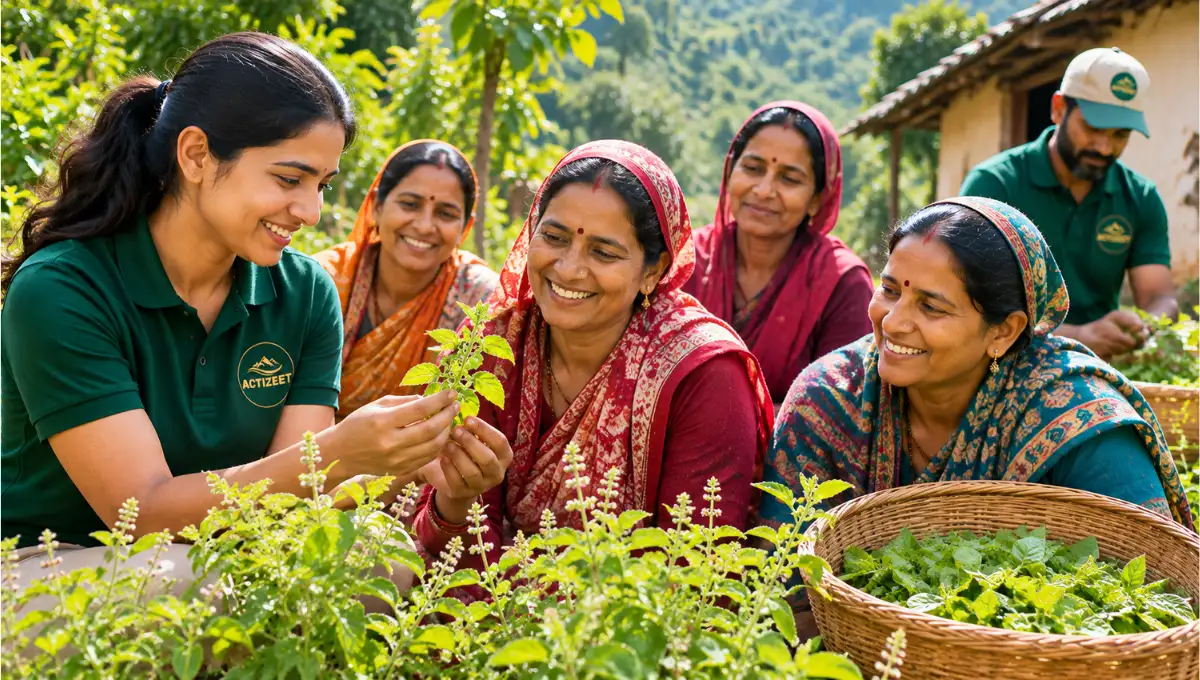
How Tulsi Became a Game-Changer for Village Women
For generations, the tulsi plant has stood in the courtyards of Indian homes as a symbol of faith and care. Today, in many villages, that same humble plant is doing something new: putting money in women's hands, building their confidence and giving families a more secure future. This is the story of how tulsi farming is quietly changing rural women's lives, what the research shows, and what it takes to make that change last.
Walk into almost any village in India early in the morning and you will see a woman watering a tulsi plant. It might grow in a raised clay pot called a tulsi vrindavan, beside the front door or in the middle of the courtyard. She lights a diya, folds her hands and moves on to the long list of chores that fill her day: fetching water, cooking, caring for children and elders, tending animals and working in the fields.
For most of these women, the tulsi plant has always been about devotion and family wellbeing. It has rarely been about income. Yet the same plant they know so well, Ocimum sanctum (holy basil), is one of India's most valued medicinal herbs. Its leaves are dried for herbal teas, ground into powder, distilled for essential oil and used in Ayurvedic products sold across the country and the world.
When women begin to grow tulsi not just for prayer but as a crop, something powerful happens. A familiar plant becomes a doorway to earning, learning and decision making. This article looks at how that shift happens, why tulsi suits village women so well, and how families, communities and responsible brands can help it grow.
Tulsi is becoming a game-changer for village women because it is familiar, quick to grow, needs relatively little water, can be grown on small plots close to home and has steady demand in the herbal market. In one Uttarakhand programme studied by researchers, about 90% of the farmers who took up tulsi were women, and 97% of those women went on to earn an independent income from it. The real change comes when women are supported with training, fair markets and collective groups, so that a sacred plant becomes a dependable livelihood.
From Sacred Plant to Source of Income
Tulsi holds a special place in Indian life. It is linked to the goddess Tulsi in Hindu tradition, worshipped during Tulsi Vivah, and used in home remedies for coughs, colds and everyday wellness. Ayurveda calls it a rasayana, a rejuvenating herb. Almost every rural woman grows up knowing how to care for it.
That familiarity is exactly what makes tulsi such a good starting point for a livelihood. Many livelihood schemes ask women to learn completely new skills or work with unfamiliar crops. Tulsi is different. Women already know how it grows, how much water it needs and how to pick its leaves. What they often lack is the knowledge to grow it on a larger scale, process it properly and sell it at a fair price.
Meanwhile, the demand for tulsi has grown steadily. Tulsi tea, tulsi powder, tulsi drops, tulsi essential oil and Ayurvedic products containing tulsi are now common in Indian homes and abroad. Buyers need a steady supply of clean, well dried, good quality leaves. Village women, with the right support, are well placed to provide it.
Why Tulsi Suits Village Women So Well
1. It Grows Quickly
According to cultivation guidance from Tamil Nadu Agricultural University's TNAU Agritech Portal, tulsi is ready for its first harvest about 90 days after planting, with further harvests roughly every 75 days. That means a woman can see income from her crop within a single season, rather than waiting the six months or more that many cereal crops need.
2. It Needs Small Plots and Simple Tools
Tulsi does not need large fields or heavy machinery. It can be grown on small patches of land near the home, on field edges or in kitchen gardens. Most of the work, from planting to picking leaves, can be done by hand. This makes it practical for women who may not own large plots or who need to stay close to home to care for family members.
3. It Fits Around Daily Responsibilities
Rural women often carry a double load of housework and farm work. Tulsi farming involves short, flexible tasks such as watering, weeding and picking leaves, which can fit into the gaps of a busy day. Plots near the house mean less time travelling to distant fields.
4. It Is Hardy and Uses Less Water
Tulsi tolerates a wide range of soils and climates, though it does not like waterlogged, saline or very alkaline land. Compared with water hungry crops such as paddy, it is often a better fit for rain fed and water scarce areas. Farmers in hill regions also report that tulsi is less attractive to wild animals than many food crops, which reduces crop losses.
5. It Is Easy to Propagate
Tulsi can be grown from seed in a small nursery or from cuttings taken from healthy plants. Once a woman has a few healthy plants, she can multiply them herself, which keeps costs low.
6. It Has Many Products
Tulsi leaves can be sold fresh or dried, ground into powder, packed as herbal tea, blended with ginger or lemongrass, or distilled into essential oil. Each step of processing adds value, and many of these steps can be done by women in their own village.
7. It Carries Cultural Respect
Because tulsi is sacred, families are often supportive when women grow it. Working with tulsi is seen as respectable and in keeping with tradition, which can make it easier for women to take part.
What the Research Shows
The idea that tulsi can change women's lives is not just a hopeful story. It has been studied. A 2019 study published in the journal Sustainability by Shah and colleagues looked at a programme that promoted tulsi farming among smallholder farmers in the hills of Uttarakhand, where many men migrate to cities for work and women are left managing both home and farm.
The findings were striking:
- Women led the way: About 90% of the first farmers to take up tulsi were women.
- Independent income: The programme enabled 97% of the women involved to earn an independent income from tulsi farming.
- Better than the old crop: On a small comparison plot of 0.02 hectares, the researchers reported that paddy cultivation resulted in a net loss of about ₹1,400, while tulsi brought a net profit of about ₹2,050.
- Faster crop: Tulsi took about three to four months to harvest, compared with six to seven months for cereal crops, allowing two tulsi cycles between May and October.
- Growing interest: The number of farmers grew from about 200 farmers on 8.72 hectares in 2013 to more than 400 farmers on 19.6 hectares across 19 villages in 2017.
- Groups made the difference: About 94% of respondents said producer and collector groups were the top factor behind higher earnings.
The researchers were also honest about the limits. Their samples were small, some data relied on farmers' memories, and they noted that market risks need careful handling and that social equity for women deserves more attention. Still, the study offers clear evidence that, with the right support, tulsi can give rural women a meaningful income of their own.
A Day in the Life: One Woman's Tulsi Journey
The story below is a composite, drawn from the kinds of experiences commonly shared by women in herbal farming programmes. It is meant to illustrate the journey, not to describe a single real person.
Meena wakes before sunrise, as she always has. She waters the tulsi in her courtyard, says a short prayer and starts the fire for breakfast. But these days, her morning has one new task. After the children leave for school, she walks a few minutes to a small patch of land behind her house, where neat rows of tulsi plants stand knee high.
Two years ago, this land grew a small crop of wheat that barely fed the family for a few months. Her husband works in a city far away and sends money home when he can. Meena had little cash of her own. Every small purchase, from school notebooks to medicines, meant asking someone else.
Then a women's group in her village started meeting to learn about tulsi farming. At first, Meena was doubtful. Everyone grows tulsi, she thought. Who would pay for it? But the group learned how to raise healthy seedlings, plant in rows, harvest at the right time and dry the leaves in the shade so they kept their colour and aroma. Most importantly, the group sold its tulsi together, which helped get a better price.
Her first harvest came in about three months. When she received her share of the payment, it was not a huge amount. But it was hers. She bought new school uniforms for her children and put a little aside in the group's savings. With each season, she has learned more. She now helps newer members with their nurseries, and she speaks up at group meetings in a way she never did before.
"Earlier, I only knew tulsi as a plant for puja," she says. "Now it is also my work, and my identity."
From Seed to Sale: How Tulsi Farming Works
| Stage | What Women Do | Why It Matters |
|---|---|---|
| Nursery | Sow seeds in nursery beds or root healthy cuttings | Strong seedlings mean a better crop and lower costs |
| Planting | Transplant seedlings in neat rows on prepared land | Proper spacing gives better growth and easier harvesting |
| Care | Water, weed and use organic manure | Healthy plants produce more leaves of better quality |
| Harvest | Cut plants or pick leaves at the right stage, usually from about 90 days | Timely harvesting improves yield and allows regrowth |
| Drying | Dry leaves in the shade on clean surfaces | Shade drying protects colour, aroma and quality |
| Cleaning and sorting | Remove stems, dust and damaged leaves | Clean, sorted leaves fetch better prices |
| Value addition | Grind into powder, blend herbal teas or pack dried leaves | Processing increases income from the same harvest |
| Collective sale | Pool produce through a group and sell to buyers | Bigger volumes and stronger bargaining power |
Cultivation guidance from TNAU notes that tulsi can yield around 10,000 kg of herbage per hectare in a year, and more when irrigated. Even on small plots, careful growing and good post harvest handling can make a real difference to what a woman earns.
More Than Money: The Wider Change
Financial Independence
The most obvious change is income. For many rural women, tulsi money is the first income they have ever controlled. It pays for school fees, books, medicines and household needs, and often goes into group savings that can be borrowed from in emergencies.
A Voice in Decisions
When women earn, they often gain more say in household decisions. In the Uttarakhand study, families reported making decisions jointly. Earning also gives women confidence to speak at group meetings, deal with buyers and take part in village life.
New Skills and Knowledge
Through training, women learn about nurseries, organic farming, harvesting, drying, quality standards, record keeping and basic business skills. These skills stay with them and can be applied to other herbs and crops.
Better Futures for Children
Women commonly spend their income on their children's education, nutrition and health. When mothers earn, the benefits often reach the next generation.
Stronger Communities
Women's groups that start with tulsi often grow into wider networks of support. Members help each other with childcare, savings, loans and advice. They also become role models for younger women in the village.
Care for the Land
Tulsi is often grown with organic methods and can be a useful way to diversify farms beyond a single cereal crop. Diverse farms tend to be more resilient to bad seasons, and tulsi flowers attract bees and other pollinators.
The Power of Women's Collectives
If there is one lesson from tulsi livelihood programmes, it is this: women do better together. A single woman with a small plot has little power to negotiate prices, buy inputs in bulk or meet a large buyer's quality requirements. A group of women can do all of these things.
- Self help groups (SHGs): Help women save regularly, access small loans and build trust.
- Producer groups and farmer producer organisations (FPOs): Pool produce, manage quality and sell directly to buyers.
- Shared facilities: Common nurseries, drying sheds, grinders and storage reduce costs for everyone.
- Shared learning: Experienced members train new ones, spreading knowledge quickly.
- Collective bargaining: Larger, consistent volumes attract better buyers and fairer prices.
This is why the Uttarakhand researchers found that producer and collector groups were the single biggest factor behind higher earnings.
Every herbal product we choose connects us to the farmers and communities who grow it.
Explore Herbal Products by ACTIZEET®Challenges and How to Overcome Them
Tulsi farming is not a magic solution. Like any livelihood, it comes with real challenges.
| Challenge | Why It Matters | What Helps |
|---|---|---|
| Market uncertainty | Without assured buyers, farmers risk unsold produce | Buy back arrangements, collective selling and links with responsible brands |
| Price swings | Prices can fall in good harvest years | Value addition, storage and diversified products |
| Quality standards | Buyers need clean, well dried, contaminant free leaves | Training in harvesting, shade drying, cleaning and storage |
| Workload | Women already carry heavy household duties | Plots close to home, shared facilities and family support |
| Access to land and credit | Many women do not own land or have savings | SHG loans, community land use and supportive schemes |
| Fair share of income | Money may not always stay in women's hands | Direct payments to women, bank accounts and awareness |
Addressing these challenges takes patience and partnership between communities, local organisations, agricultural experts, government schemes and businesses that buy herbs.
How You Can Be Part of the Change
The journey of tulsi from courtyard to marketplace does not end in the village. It continues in every kitchen and home where herbal products are used. Each of us can help make that journey fairer.
- Choose herbs with care: Prefer brands that are open about where their herbs come from and how they are processed.
- Value quality over the cheapest price: Fair prices allow farmers to invest in better practices.
- Support women led enterprises: Look out for products made by women's groups and rural collectives.
- Share the story: Talking about the people behind our herbs helps build respect for their work.
- Grow a little tulsi yourself: Keeping the tradition alive at home reminds us where our herbs begin.
At ACTIZEET® Cares, the CSR initiative of ACTIZEET®, we believe that the herbs that support our wellbeing should also support the people who grow them. Stories like the tulsi journey remind us that herbal farming can be a path to dignity, income and confidence for rural women. Through our focus on herbal farming and livelihoods, we hope to encourage and contribute to efforts that help farming communities grow, learn and thrive.
Discover the ACTIZEET® Herbal Range →Frequently Asked Questions
A Sacred Plant, a New Beginning
Tulsi has always been a plant of care, grown by women for the wellbeing of their families. Today, it is proving that it can also be a plant of change. With its short growing cycle, low water needs, small land requirements and steady demand, tulsi offers village women a realistic path to earning their own income, learning new skills and gaining a stronger voice at home and in their communities. Research from the hills of Uttarakhand shows what is possible when women are supported with training, collective groups and fair markets.
The challenge now is to make sure that more women can walk this path, and that the value of every tulsi leaf reaches the hands that grew it. That is a journey all of us, as farmers, communities, brands and consumers, can share.
References
- Shah GM, Ahmad F, Panwar S, Khadka MS, Ali A, Bisht S. Ocimum sanctum [Tulsi]: An alternative additional livelihood option for the poor and smallholder farmers. Sustainability, 2019; 11(1): 227.
- TNAU Agritech Portal. Tulsi: Medicinal Crops, Horticulture. Tamil Nadu Agricultural University.
Latest from Our Blog
How Tulsi Became a Game-Changer for Village Women
Discover how tulsi farming is helping village women in India...

How ACTIZEET® Supports Fair Pricing for Growers
Learn how ACTIZEET® supports fair pricing for growers through transparent...

Top 5 Medicinal Herbs Grown by ACTIZEET Farmers
Discover the top 5 powerful medicinal herbs cultivated by ACTIZEET...
A Beginner’s Guide to Organic Herbal Cultivation
Learn how to start your journey in organic herbal cultivation....

