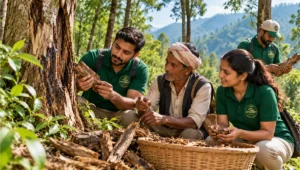
A Transparent Approach to Measuring Grassroots Progress
How do you know if a village development project is truly working? Is it enough to build a new toilet, install a water tank, or hold a training session? Not unless you can answer a simple question: Did it improve lives—and how do we know?
At ACTIZEET CARES, we believe that real change demands real evidence. That’s why, throughout 2024, our initiatives have included data collection, impact tracking, and community feedback mechanisms to ensure every intervention counts—not just on paper, but in people’s daily lives.
This blog explores our methods, learnings, and outcomes from tracking change at the village level. It is a journey of turning anecdotes into insights, and hopes into measurable outcomes.
Why Track Change at the Village Level?
India is home to over 600,000 villages, each with its unique strengths and struggles. Despite government schemes and NGO efforts, there’s often a disconnect between planning and ground reality.
The Common Gaps:
- Lack of localized data
- Programs designed top-down without local context
- Short-term outputs being mistaken for long-term impact
- No feedback loops from beneficiaries
Tracking village-level change helps us:
- Tailor solutions to local needs
- Identify which efforts are working—and which aren’t
- Allocate resources more effectively
- Empower communities through transparency
For ACTIZEET CARES, data isn’t just about numbers—it’s a tool for inclusion, learning, and growth.
ACTIZEET CARES: A Ground-Up Model for Monitoring
Our tracking system doesn’t rely solely on experts in distant offices. It combines technology, community participation, and continuous feedback.
1. Baseline Assessments
Before starting any intervention—be it a health camp, women’s training, or tree plantation—we conduct baseline surveys that document:
- Existing infrastructure (toilets, water sources, schools)
- Health and hygiene practices
- Literacy and income levels
- Access to government schemes
- Gender roles and decision-making
This acts as our starting point, against which all future changes are compared.
2. Real-Time Digital Data Collection
We use mobile-friendly tools to collect, store, and analyze data. Our field teams input:
- Attendance at workshops
- Distribution records (e.g., sanitary kits, herbal saplings)
- Follow-up health check details
- SHG savings progress
- Behavioral indicators (handwashing frequency, school attendance)
All of this is geo-tagged and time-stamped for accuracy.
The Human Side of Data: Village Volunteers
Numbers alone don’t tell stories. That’s why we train Village Impact Volunteers—local youth or ASHA workers—who:
- Conduct household visits
- Explain survey questions in local dialects
- Observe behavior and context beyond what forms capture
- Help verify entries and avoid duplication
Their insights often shape how we interpret data. For example, a dip in school attendance wasn’t just a statistic—it led us to discover menstrual hygiene issues keeping girls at home. The solution? Awareness + sanitary pad distribution.
Three Pillars of ACTIZEET’s Data-Driven Impact Framework
Our impact tracking rests on three interconnected pillars:
1. Output Monitoring
Tracks what was done:
- Number of trainings held
- Items distributed
- Events conducted
📍 Example: 22 compost pits constructed in 4 villages
2. Outcome Tracking
Measures behavioral and social changes:
- Are villagers using toilets regularly?
- Are women applying what they learned in training?
- Are farmers adopting herbal techniques?
📍 Example: 68% of women from our training batches are earning through home-based herbal product sales
3. Community Feedback
Checks perception and satisfaction:
- Did they find the activity useful?
- Would they recommend it to others?
- What do they want to see next?
📍 Example: 92% of participants in Ladakh learning centers said they felt more confident in class after attending ACTIZEET Learning sessions
Case Study: Measuring Sanitation Progress in Bihar
In early 2024, we launched a sanitation and hygiene drive in 7 villages across Bihar. Here’s how we tracked the results:
Baseline Findings:
- 42% households lacked toilets
- 61% did not wash hands before meals
- 70% women used cloth for menstrual hygiene
After 6 Months:
- 88% of homes now have functional toilets
- 74% reported handwashing with soap
- 4,300 sanitary napkin packs distributed, with 1,200+ women regularly using them
How We Tracked It:
- Monthly visits by health educators
- Spot checks and school monitoring
- Anonymous community satisfaction surveys
- Data visualized on dashboards for decision-making
Challenges in Tracking Rural Data
No model is perfect. We faced several challenges:
1. Digital Divide
Many villages have poor network connectivity. We trained field workers to store offline and sync when possible.
2. Response Fatigue
Repeated surveys led to disinterest. We kept interviews short, offered snacks, and ensured transparency in why the data mattered.
3. Data Interpretation
A rise in herbal usage didn’t automatically mean higher income. We added follow-up income interviews to get clearer financial impact.
How Communities React to Data Sharing
One powerful learning: sharing data with villagers builds trust and ownership.
When we showed local women their SHG’s savings growth in graphs, they felt pride. When children saw test scores improving post-learning center enrollment, they felt motivated.
📍 Information isn’t just for planners—it belongs to the people. We make sure they understand and use it.
What’s Next: Scaling Smart Monitoring
In the second half of 2024, ACTIZEET CARES will invest further in our tracking system:
Upcoming Upgrades:
- AI-based data validation tools to flag anomalies
- Interactive community dashboards in local languages
- Voice-based feedback systems for illiterate participants
- Integration with government platforms for holistic development mapping
We’re also preparing to publish open-source reports from select villages so other organizations can learn and replicate our methods.
A Note on Privacy and Ethics
ACTIZEET CARES is committed to data ethics. All surveys are voluntary. No personally identifiable information is shared externally. Feedback is anonymous unless consent is given.
Transparency and dignity are central to our process—because tracking change shouldn’t compromise the very people it aims to help.
Closing Thoughts: When Numbers Tell Human Stories
Development isn’t just about building more—it’s about building better. And building better begins with knowing what’s working, and where we need to improve.
At ACTIZEET CARES, tracking village-level change with real data is not a formality. It’s a philosophy. It keeps us grounded. It helps us learn. And most importantly, it helps ensure that every rupee spent and every effort made moves the needle on rural wellbeing.
If change is a journey, then data is our map. And it’s a map that leads us—not toward assumptions—but toward authentic impact.