
How Clean Toilets Transformed a Himalayan School
A school toilet does not make headlines. It is not a new science lab or a smart classroom. Yet in a small mountain school, a clean, safe and working toilet block changed who came to class, how long they stayed and how they felt about themselves. This is the story of how something so basic became the turning point for an entire school community.
Picture a government school perched on a hillside, a short climb above the village. Around 140 children study here, from Class 1 to Class 8. The classrooms are bright, the teachers are dedicated and the views of the snow peaks are stunning. But for years, the school had one quiet problem that nobody liked to talk about: its toilets.
This article follows how clean toilets in schools can change far more than hygiene. Through the experience of one Himalayan school, it shows what went wrong before, how the community and partners fixed it, what changed for students and teachers, and what other schools, panchayats and CSR teams can learn from the process.
The Hidden Problem in School Sanitation
India has made huge progress on sanitation over the past decade. Under the Swachh Vidyalaya campaign launched in 2014, lakhs of school toilets were built, and today most schools have at least one toilet on paper. But having a toilet and having a toilet that children can actually use are two very different things.
Across the country, many school toilets are locked, broken, without water, too dirty to enter or shared by boys and girls. The problem is global too. A WHO and UNICEF Joint Monitoring Programme report found that around one in five schools worldwide lacked a basic sanitation service, and that only about a third of schools had bins for menstrual waste in girls' toilets (WHO/UNICEF JMP, 2024). A more recent WHO-UNICEF update reported that about 50 million children in India still lacked sanitation services at school in 2025 (The Pioneer).
Why the Mountains Make It Harder
In Himalayan regions, these challenges grow sharper. Water sources may be far downhill. Pipes freeze in winter. Rocky ground makes pits and drainage difficult to build. Supplies for repairs have to be carried up steep paths. A toilet that works well in the plains can fail within one harsh mountain winter if it is not designed for local conditions.
The School Before the Change
The school in this story had two toilet seats built some years earlier, shared by all 140 children and their teachers. Over time, one door broke and the other would not lock. There was no running water inside, so children had to carry buckets from a tap near the gate. In winter, that tap often froze. The toilets soon became dirty, smelly and unsafe, and most children stopped using them.
What That Meant for Children
Boys mostly went behind the school building or into the trees on the slope. Younger children often waited until they got home, sometimes for six hours or more. Teachers noticed children drinking very little water during the day so they would not need the toilet, which left them tired and unable to focus, especially in the afternoon.
What That Meant for Girls
For adolescent girls, the situation was much harder. With no private, lockable space, no water and nowhere to dispose of sanitary pads, many girls stayed home for two to four days every month during their periods. Some older girls, already struggling to keep up after missing classes, began talking about leaving school altogether. Parents worried about their daughters' safety when they had to go into the forest to relieve themselves.
Starting by Listening
The change did not begin with bricks or cement. It began with conversations. Teachers, the School Management Committee, the gram panchayat, parents and the students themselves sat together to talk about what was going wrong. Girls were given a separate space, with a female facilitator, to share their concerns openly.
The children's answers were simple and clear. They wanted toilets that were clean, had water, had doors that locked, and were not far from the classroom. Girls wanted separate toilets, a place to change and wash, and a way to dispose of pads quietly. Teachers wanted a plan for who would clean and repair the toilets, so the new facilities would not end up like the old ones.
These conversations shaped every decision that followed. The project became a partnership, with the community contributing labour and local knowledge, and outside support filling the gaps in materials, design and training.
Six Changes That Made the Difference
The new toilet block was designed for the local climate and ground. It had separate sections for boys and girls, with enough seats to avoid long queues at break time. Walls were insulated, and the block was placed on a sunny side of the school to reduce freezing. A small step-free unit was built for children with disabilities. Child-sized seats and lower fittings helped the youngest students, who had often been afraid of the old toilets.
A toilet without water quickly becomes unusable. The project added a roof rainwater collection system with a covered storage tank, connected by insulated pipes to the toilet block. Taps were fitted inside each section, so children no longer had to carry buckets. In the coldest weeks, a simple routine of filling buckets from the stored tank each morning kept the toilets working even when pipes slowed down.
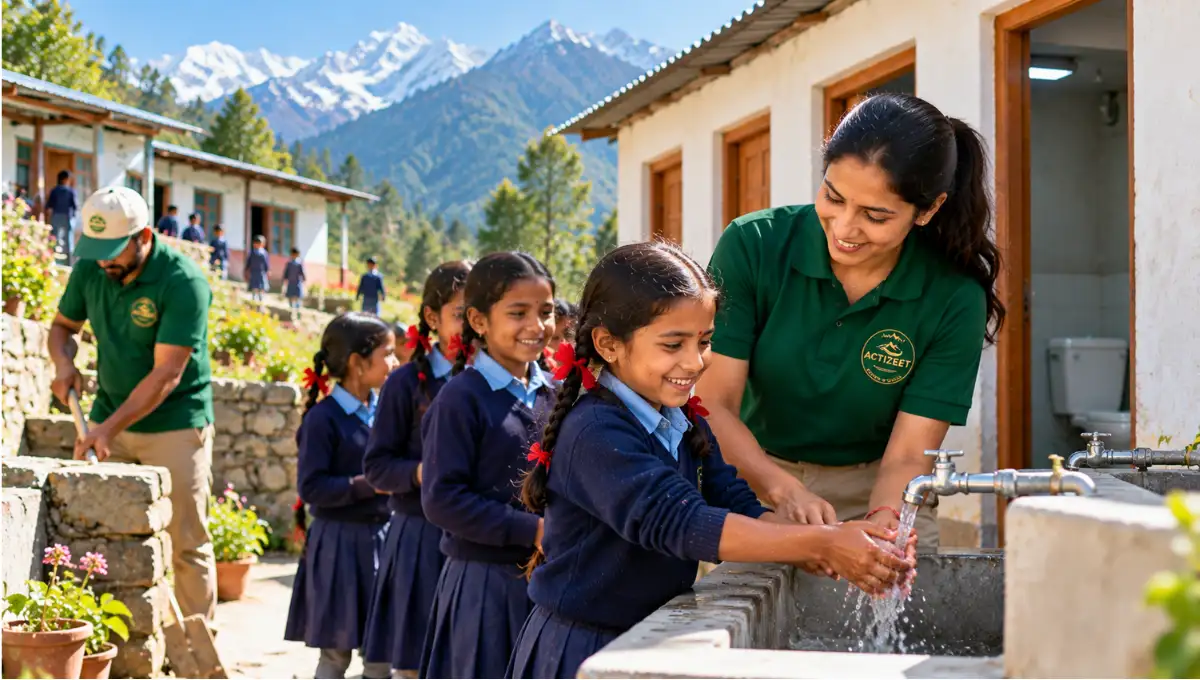
A group handwashing station was installed right outside the toilets, at a height suitable for younger children, with several taps so a whole class could wash at once before the mid-day meal. Soap was kept stocked through a small school budget line and community support. Teachers built handwashing into the daily routine: after the toilet, before eating and after play.
The girls' section included a private changing and washing space, hooks, a mirror, a covered bin for used pads and a small, safe incinerator for disposal. A supply of sanitary pads was kept with a female teacher for emergencies. Equally important, girls received menstrual health sessions that explained periods in simple, factual terms, helped break myths and encouraged them to ask questions without shame.
Students from Classes 6 to 8 formed a hygiene club, with both boys and girls as members. They took turns checking that toilets were clean, soap was available and water was filled. They led short morning assembly talks on handwashing and staying healthy, and even ran a weekly competition between classes for the cleanest classroom. Giving children ownership turned sanitation from a rule into a matter of pride.
Many school toilets fail not because they were badly built, but because nobody owns their upkeep. This time, the School Management Committee agreed on a written plan. A local helper was paid a small monthly amount for daily deep cleaning. A maintenance fund, supported by the panchayat and community, covered repairs, soap and cleaning supplies. A simple checklist on the wall let anyone see when the toilets were last cleaned.
Small daily habits build healthier communities. Explore everyday wellness essentials from ACTIZEET®.
Explore ACTIZEET®What Changed After
The new toilets opened at the start of the school year. Within a few months, teachers, parents and students began noticing changes, some expected and some surprising.
Girls Stopped Missing School
The most visible change was in attendance among adolescent girls. With private toilets, water, disposal facilities and emergency pads, most girls no longer felt they had to stay home during their periods. Teachers noticed that girls who had been falling behind began catching up. Two older girls who had talked about dropping out decided to continue their studies to Class 10 in the nearby high school.
Fewer Stomach Upsets and Sick Days
Regular handwashing with soap before the mid-day meal, and no more open defecation on the slope behind the school, meant fewer cases of diarrhoea and stomach pain. Parents mentioned that their children were falling ill less often, which meant fewer missed school days and fewer trips to the health centre.
Better Focus in Class
Once children knew they could use a clean toilet, they began drinking water normally through the day. Teachers said children seemed less restless and more alert in afternoon lessons. Younger children, who had once been anxious about needing the toilet, settled in better.
Confidence and Pride
Perhaps the biggest change was in how the children felt about their school. The hygiene club members took their roles seriously and spoke proudly about "their" toilets. Visitors from nearby villages came to look, and students happily showed them around. Girls who had once felt embarrassed about periods began speaking about menstrual health more openly with teachers and each other.
Habits That Travelled Home
The lessons did not stay at school. Children reminded parents and younger siblings to wash hands with soap before eating. Several families in the village improved their own household toilets or added handwashing points at home. In this way, one school's sanitation project slowly lifted hygiene standards across the community.
Before and After at a Glance
| Area | Before | After |
|---|---|---|
| Toilet access | Two shared, broken seats for all students | Separate, lockable boys' and girls' toilets plus an accessible unit |
| Water | Buckets carried from a tap that froze in winter | Rainwater tank and insulated pipes with taps inside |
| Handwashing | No soap, rarely practised | Group handwashing station with soap, part of daily routine |
| Menstrual hygiene | No privacy, disposal or information | Private space, disposal, emergency pads and health sessions |
| Upkeep | No one responsible | Paid cleaner, maintenance fund and student hygiene club |
| Girls' attendance | Several days missed each month | Much more regular attendance |
Challenges Along the Way
The journey was not smooth. Carrying cement, pipes and tanks up the hillside took weeks of shared effort from village families. The first winter tested the water system, and a section of pipe had to be rerouted and better insulated. Soap supplies ran short at times until the maintenance fund became regular. Some parents initially felt menstrual health sessions were unnecessary, until female teachers and health workers met them to explain why the sessions mattered. Each problem was solved by returning to the same partners who had shaped the plan from the start.
ACTIZEET® Cares believes community development starts with the basics that protect health and dignity. A clean, safe toilet may seem simple, but for a child in a mountain school, it can decide whether learning continues or stops.
Learn More About ACTIZEET® Cares →Why the Investment Was Worth It
Compared with a new classroom or a computer lab, a well-designed toilet block costs relatively little. Yet its returns show up every single school day, in children who stay healthy, girls who keep attending and teachers who spend less time dealing with discomfort and absence. For any school or CSR team deciding where to begin, sanitation is often the investment that makes every other investment work better.
Lessons for Other Schools and Communities
For schools, panchayats, NGOs and CSR teams working on school sanitation in India, especially in hill and mountain areas, this experience points to a set of practical principles.
- Listen to children first, and give girls a private space to share their needs.
- Build separate, lockable toilets for boys and girls, with enough seats for the number of students.
- Plan water supply from the start, and design for frost, slope and local ground conditions.
- Place handwashing stations with soap right outside the toilets, at child-friendly heights.
- Include menstrual hygiene facilities and education as standard, not as an extra.
- Make toilets accessible for children with disabilities.
- Agree on a written upkeep plan, with clear roles and a small regular budget.
- Give students real responsibility through hygiene clubs or monitors.
- Link with government programmes such as Samagra Shiksha and Swachh Bharat Mission for support and sustainability.
Frequently Asked Questions
Small Building, Big Change
A toilet block is one of the smallest buildings on any school campus. Yet in this Himalayan school, it brought girls back to class, cut down on illness, helped children focus, gave students pride in their school and carried better hygiene habits into homes across the village. The lesson is clear: when sanitation is planned with the community, designed for local conditions and cared for every day, it changes far more than hygiene.
ACTIZEET® Cares continues to support community development that begins with the basics, because health, dignity and education grow from the ground up.
Sources referenced: WHO/UNICEF Joint Monitoring Programme, Progress on WASH in Schools 2015-2023 (2024) and The Pioneer, reporting on the WHO-UNICEF WASH in Schools 2015-2025 update.
Latest from Our Blog
How Clean Toilets Transformed a Himalayan School
A case study on how clean, safe school toilets in...
Why Rainwater Harvesting Is Reshaping Rural India
Discover how rainwater harvesting, from revived traditional structures to community-led...

ACTIZEET® Cares Rural Internship Program: What We Learned
Discover key lessons from the ACTIZEET® Cares Rural Internship Program,...
Village by Village: Our Blueprint for Upliftment
Discover how ACTIZEET is uplifting Himalayan communities—village by village—through herbal...

